.png)
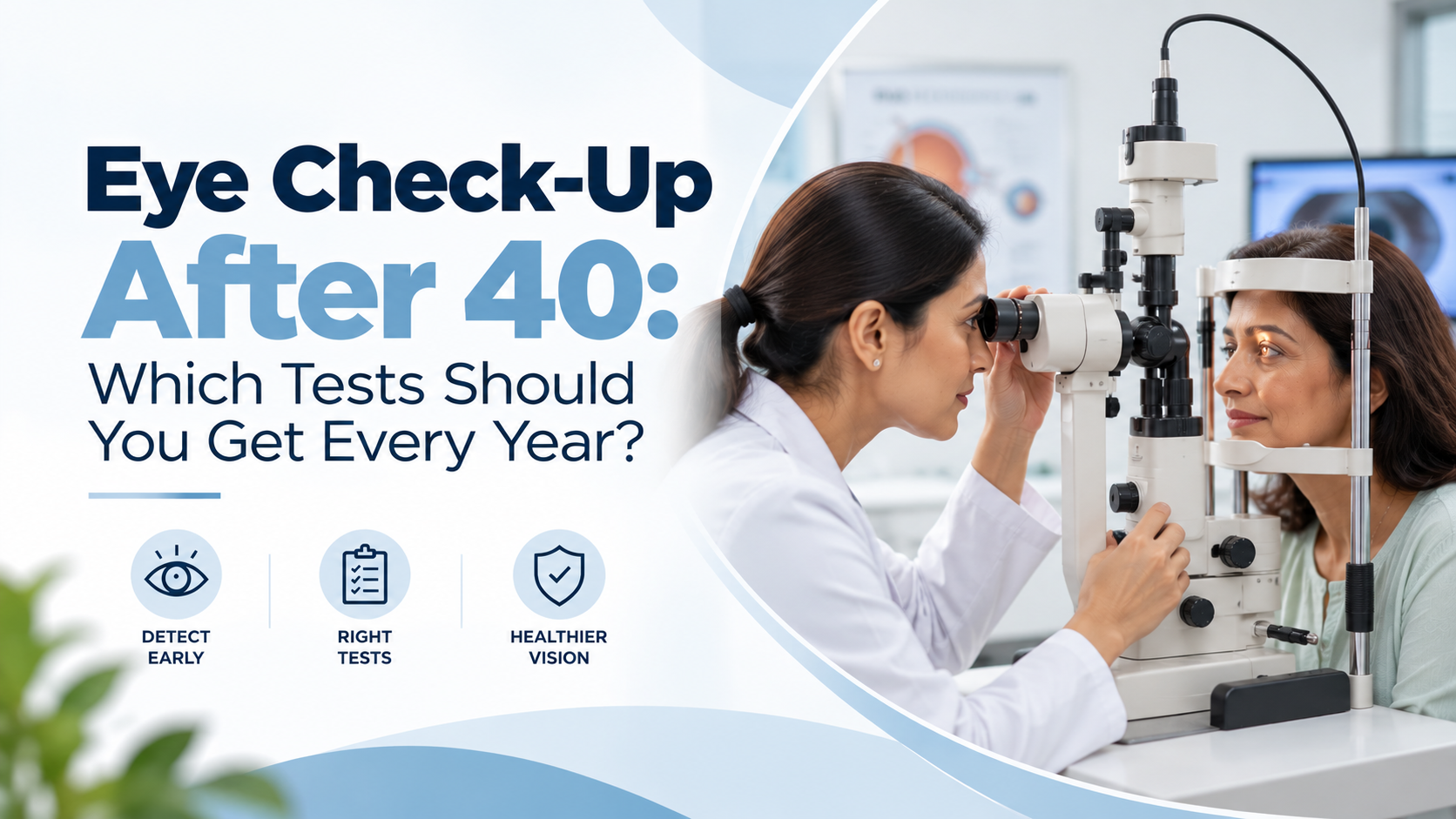
Eye Check-Up After 40: Which Tests Should You Get Every Year?
Your vision may change with age — but many eye problems can begin without obvious symptoms.
After 40, certain age-related eye conditions become more common, including cataracts, glaucoma, and other retinal or macular problems. Some conditions may develop gradually without noticeable symptoms, which is why regular comprehensive eye examinations are important.
But what exactly should an eye check-up after 40 include?
1. Visual Acuity Test
This is the familiar eye-chart test that checks how clearly you can see at different distances.
It can identify changes in your vision and determine whether you may need glasses or a change in your existing prescription.
2. Refraction & Prescription Check
Your eye power can change as you get older. A refraction test helps determine whether you need glasses and what prescription provides clearer vision.
After 40, some people also begin experiencing presbyopia, which can make reading or seeing nearby objects more difficult.
3. Eye Pressure Test
An eye pressure test, or tonometry, measures the pressure inside your eyes.
It is one part of a glaucoma evaluation. However, eye pressure alone cannot diagnose or rule out glaucoma; a complete eye examination is needed.
4. Slit-Lamp Examination
A slit-lamp examination allows the eye specialist to closely examine structures at the front of the eye, including the cornea, iris, and lens.
It can help identify conditions such as cataracts and other problems affecting the eye's front structures.
5. Retina & Optic Nerve Examination
A dilated eye examination allows the doctor to examine the retina and optic nerve more thoroughly.
This can help detect or monitor conditions such as glaucoma, diabetic retinopathy, cataract-related changes, and other retinal problems. Many eye diseases can exist before noticeable symptoms appear.
6. Visual Field Test
A visual field test checks your peripheral, or side, vision.
This can be particularly useful when evaluating for glaucoma because early glaucoma may gradually affect peripheral vision without obvious symptoms.
7. OCT Scan — When Recommended
An OCT (Optical Coherence Tomography) scan creates detailed images of the retina and other structures at the back of the eye.
Your ophthalmologist may recommend an OCT when there are symptoms, risk factors, or clinical findings that require a closer look at the retina, macula, or optic nerve.
Do You Really Need an Eye Check-Up Every Year After 40?
Not necessarily for everyone.
The recommended frequency depends on your age, overall health, family history, previous eye problems, and other risk factors.
Your eye specialist can recommend an appropriate examination schedule based on your individual eye health and risk factors.
People with diabetes, high blood pressure, a family history of glaucoma, previous eye surgery, eye injuries, or existing eye conditions may need more frequent monitoring.
Why Is an Eye Check-Up After 40 Important?
Regular eye examinations are not only about checking your glasses power.
A comprehensive eye check-up after 40 can help identify eye diseases before they significantly affect vision. For example, glaucoma can develop without noticeable symptoms in its early stages.
Early detection can allow your ophthalmologist to monitor the condition and recommend appropriate treatment when necessary.
When Should You Get Your Eyes Checked Immediately?
Do not wait for your routine appointment if you experience:
- Sudden loss of vision
- Sudden increase in floaters
- Flashes of light
- A curtain or shadow over your vision
- Sudden blurred or distorted vision
- Eye pain or significant redness
- New difficulty seeing with one eye
Sudden or significant changes in vision should be evaluated promptly.
Eye Check-Up in Faridabad at Drishti Eye Centre
At Drishti Eye Centre, Faridabad, a comprehensive eye examination can help assess your vision and overall eye health.
Depending on your age, symptoms, medical history, and risk factors, your ophthalmologist may recommend tests such as vision testing, refraction, eye pressure measurement, slit-lamp examination, retinal examination, visual field testing, or OCT.
If you are searching for an eye check-up in Faridabad, eye specialist in Faridabad, ophthalmologist in Faridabad, or a comprehensive eye examination in Faridabad, regular professional eye care can help you stay ahead of age-related eye changes.
Frequently Asked Questions
At what age should I start getting regular eye check-ups?
A comprehensive baseline eye examination around age 40 is recommended for adults without symptoms or risk factors. After that, the examination schedule should be based on your individual risk factors and your ophthalmologist's advice.
Is an eye pressure test enough to detect glaucoma?
No. Eye pressure is only one part of glaucoma evaluation. A comprehensive examination may also include assessment of the optic nerve, visual field, drainage angle, and other measurements.
Do people with diabetes need regular eye examinations?
Yes. Diabetes can affect the eyes, and people with diabetes often need regular dilated eye examinations. Your doctor can advise how frequently you should be examined based on your condition.
Can an eye examination detect cataracts?
Yes. An eye specialist can examine the lens and other structures of the eye to identify cataracts and assess whether they are affecting vision.
Don't Wait for Your Vision to Change
After 40, regular eye care becomes an important part of looking after your overall eye health. Even when your vision seems normal, some eye conditions may develop quietly.
Book a comprehensive eye check-up at Drishti Eye Centre, Faridabad, and discuss the right examination schedule for your eyes.
Drishti Eye Centre, Faridabad
Centre 1: 20–21F, Fruit Garden, NIT 5, Faridabad
Centre 2: Main Market, Sector 17, Faridabad
Website: www.drishtieyecentre.in
Email: info@drishtieyecentre.in

Business it will frequently occur that greater pleasures have repudiated choose enjoy pleasure that has no annoying.- Alex Jhon Martin
Making Every Step Easy
Holds in these matters too this principle off selection held rejects pleasures too secure other greater pleasures or else he endures again is there anyone who loves or pursues or desires to obtain pain of itself, because it is pain veniam, and quis nostrud exercitation produr enim ad minim venia trudco.
Leave a Reply