.png)
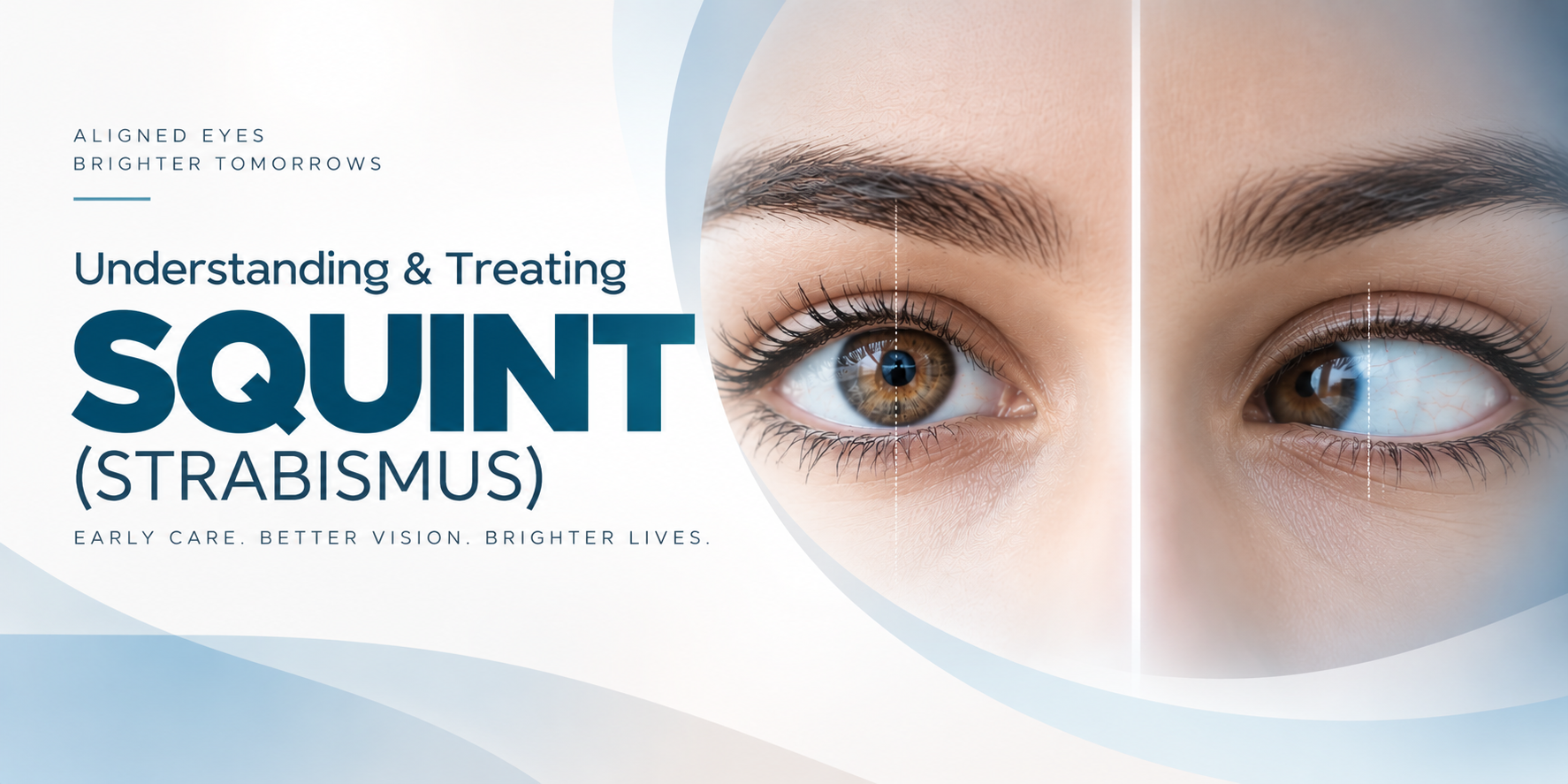
Squint (Strabismus): Symptoms, Causes & Treatment
Squint, medically known as strabismus, is a condition where the eyes do not align properly. One eye may turn inward, outward, upward or downward while the other looks straight. Squint can affect both children and adults and may be constant or occur occasionally.
At Drishti Eye Centre, Faridabad, we provide comprehensive evaluation and personalised treatment for squint and other eye conditions.
Symptoms of Squint
Common squint symptoms include:
- One eye turning inward, outward, upward or downward
- Double or blurred vision
- Headaches and eye strain
- Difficulty reading or focusing
- Tilting or turning the head to see clearly
- Closing one eye in bright light
- Poor depth perception
- Reduced vision or lazy eye (amblyopia) in children
If you notice any of these signs, an eye examination is recommended.
Causes of Squint
Squint causes can vary and may include:
- Uncorrected refractive errors such as farsightedness
- Problems with eye muscle coordination
- Amblyopia (lazy eye)
- Eye injury or certain eye conditions
- Neurological or medical conditions
- Family history or genetic factors
In adults, a newly developed squint may sometimes be associated with conditions such as diabetes, thyroid eye disease, stroke or trauma and should be evaluated promptly.
How Is Squint Diagnosed?
A comprehensive eye examination may include:
- Visual acuity testing
- Refraction and glasses-power assessment
- Eye movement evaluation
- Cover-uncover test
- Corneal light reflex test
- Binocular vision assessment
- Retinal examination
- Amblyopia assessment
Additional tests may be recommended depending on the patient's symptoms and clinical findings.
Squint Treatment Options
The appropriate squint treatment depends on the patient's age, type of squint, severity and underlying cause.
Glasses
Corrective glasses can improve vision and may correct certain types of squint caused by refractive errors.
Prism Glasses
Prism lenses may help selected adults manage double vision.
Patching
For children with amblyopia, patching the stronger eye may help improve vision in the weaker eye.
Eye Exercises
Specific exercises may be beneficial for certain types of eye misalignment and should be recommended after evaluation.
Botox
Botulinum toxin may be considered in selected cases to temporarily alter the activity of an eye muscle.
Squint Surgery
When appropriate, squint surgery (strabismus surgery) can realign the eyes by adjusting the eye muscles. It may be recommended for both children and adults.
Can Squint Be Treated Without Surgery?
Sometimes. Depending on the cause, glasses, prism lenses, patching or selected exercises may help. However, surgery may be required when non-surgical treatment is not sufficient.
Why Is Early Treatment Important?
Early diagnosis is particularly important in children. Untreated squint can contribute to lazy eye (amblyopia), reduced depth perception and problems with binocular vision.
Parents should consult an eye specialist if their child's eye frequently turns, even if the misalignment occurs only occasionally.
Squint Treatment in Faridabad
Looking for squint treatment in Faridabad?
At Drishti Eye Centre, Faridabad, our team provides comprehensive eye examinations and personalised treatment options for children and adults with squint, eye misalignment and related vision problems.
Don't ignore an eye that turns. Early evaluation can make a difference.
Frequently Asked Questions
1. What is squint?
Squint or strabismus occurs when the eyes are not properly aligned.
2. Can adults develop squint?
Yes. Adult-onset squint can have several causes and should be evaluated by an eye specialist.
3. Is squint treatable?
Yes. Treatment may include glasses, patching, prism lenses, exercises, Botox or surgery, depending on the condition.
4. Does every squint require surgery?
No. Some cases can be managed without surgery, while others may benefit from squint surgery.
5. Can children outgrow squint?
A persistent or recurring squint should not be ignored. Early examination and treatment are important to protect vision.
6. Can squint cause lazy eye?
Yes. Persistent squint in children can contribute to amblyopia, commonly called lazy eye.
Drishti Eye Centre, Faridabad
Centre 1: 20–21F, Fruit Garden, NIT 5, Faridabad
Centre 2: Main Market, Sector 17, Faridabad
Website: www.drishtieyecentre.in
Email: info@drishtieyecentre.in

Business it will frequently occur that greater pleasures have repudiated choose enjoy pleasure that has no annoying.- Alex Jhon Martin
Making Every Step Easy
Holds in these matters too this principle off selection held rejects pleasures too secure other greater pleasures or else he endures again is there anyone who loves or pursues or desires to obtain pain of itself, because it is pain veniam, and quis nostrud exercitation produr enim ad minim venia trudco.
Leave a Reply